The Mother Cat Who Asked for Help
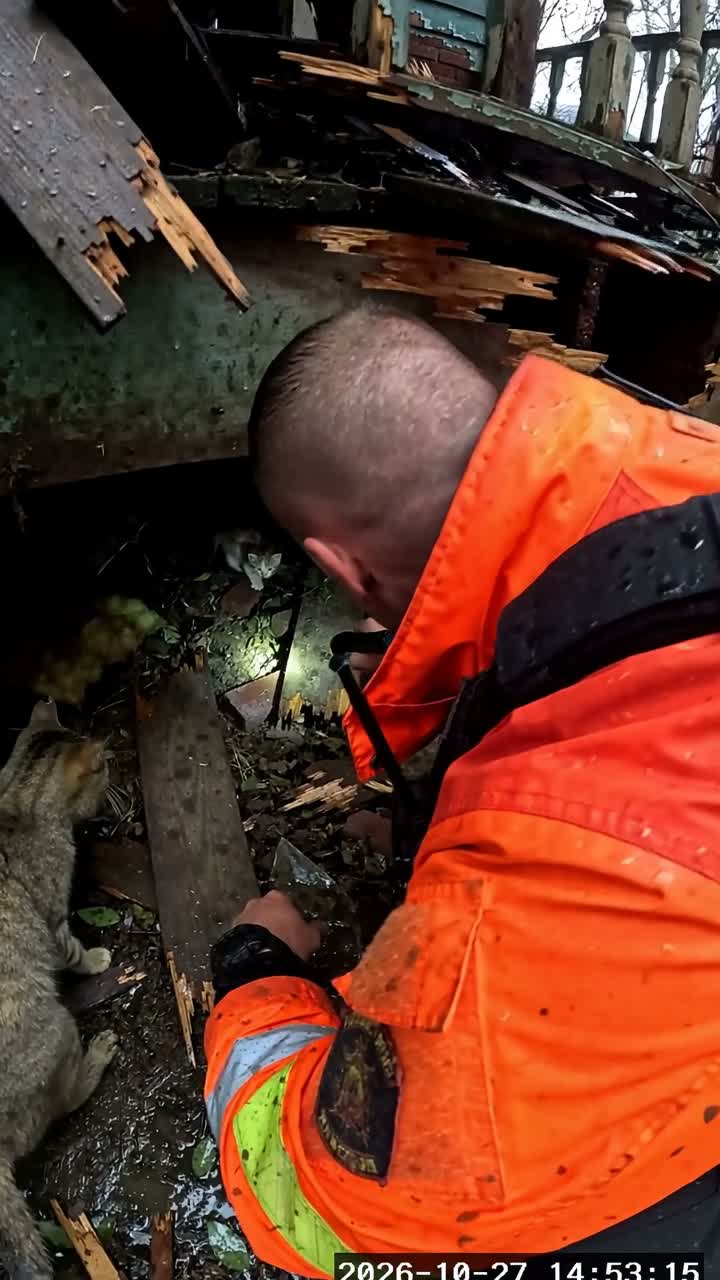
There is an old saying that cats do not have owners, only staff, and anyone who has lived with a cat knows the particular look they give you when they want something: direct, unblinking, utterly certain that you will understand. The mother cat in this story gave that look to a stranger, and she did not stop giving it until the stranger followed her. She had been pacing around the porch of a storm-damaged house, crying out in short, urgent bursts, darting toward the dark space beneath the porch and then back to the human, as if she were trying to lead a rescue party that consisted of exactly one confused person.
Under the porch, in a nest of debris and damp insulation, was her kitten: small, grey, barely old enough to have its eyes properly open, shivering in the cold air that came through the broken boards. The storm had damaged the house and scattered the family; the mother had managed to get herself out, but the kitten had not, and she had done the only thing a mother can do when she cannot reach her child alone — she had gone looking for help, and she had found it in the form of a wildlife rescuer who was willing to take a cat seriously.
The rescuer lay down on the wet ground and peered into the dark beneath the porch with a torch, and there it was: two tiny eyes reflecting back, and a small body pressed into the furthest corner. Getting it out required the kind of careful, undignified work that rescues so often do — reaching into a cramped, filthy space, moving broken boards a centimetre at a time, speaking softly the whole time, while the mother cat supervised from a few feet away with the intense focus of a foreman who does not entirely trust the contractor.
And then the kitten was out, blinking in the daylight, and the mother cat was on it instantly — not with noise, but with the quiet, thorough business of motherhood: sniffing it from nose to tail, licking its damp fur, counting it with her body, making sure it was whole. Then she picked her way to a dry spot, the kitten stumbling after her on legs that had barely learned to work, and settled down with it tucked against her side, purring loudly enough to be heard over the dripping water.
It would be easy to tell this story as a curiosity: a cat that asked a human for help. But it is more than that. It is a reminder that the line between wild and tame, between independent and dependent, is thinner than we think, and that motherhood — in any species — will cross that line without hesitation when a child is in danger. The mother cat did not know the rescuer. She did not know whether humans could be trusted. She knew only that her kitten was under the porch, and that she could not get it out alone, and that was enough. Trust, in the end, is not a luxury. Sometimes it is the only tool a mother has left, and she used it perfectly.
In the weeks that followed, the kitten grew the way kittens do when they are safe: fast, and then faster, its eyes opening fully, its legs steadying, its world expanding from a nest to a room to a garden. Its mother stayed close at first, and then, as mothers do, began to let it wander a little further each day, always within earshot, always ready. The people who fixed the porch put a board over the gap beneath it, so no other kitten would slip into the dark again — a small repair, made by someone who had seen what a gap under a porch could cost. And the rescuer, when asked about the day, does not talk about the crawl through the debris or the torchlight. He talks about the look the mother cat gave him at the start: direct, unblinking, certain. It is a look he has never forgotten, because it taught him something no training course ever did — that animals do not only need our help. Sometimes, they know how to ask for it. Our job is simply to be the kind of person who follows when they do.
