Three Ducklings in the Storm Drain
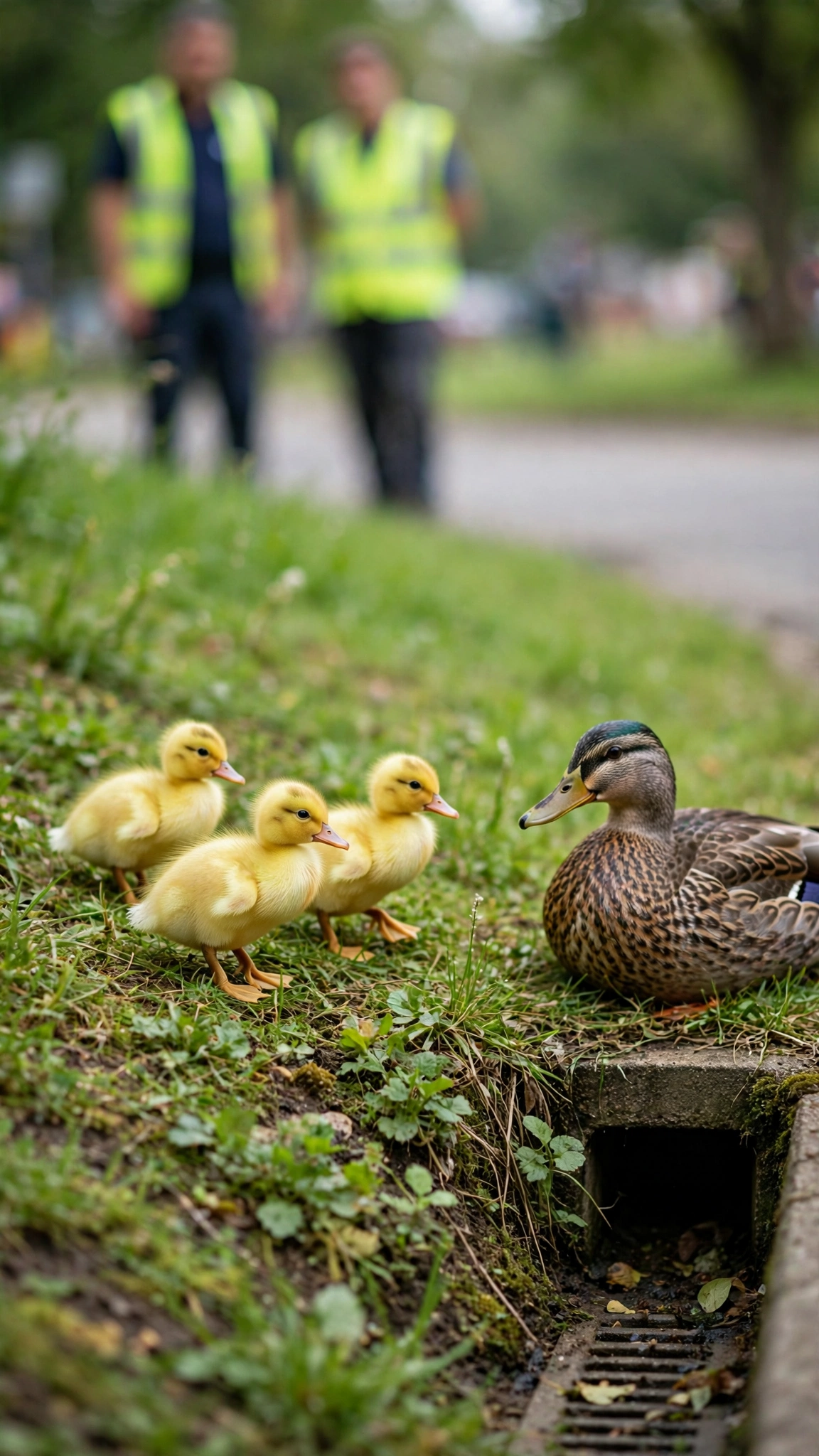
On an ordinary sunny day beside an ordinary road, a mother duck was making the most distressed sound a duck can make. She paced back and forth along the grassy bank, calling and calling, and every few steps she would return to the same spot: a metal drainage grate set into the kerb, dark and unremarkable, the kind of thing thousands of people walk past every day without a second thought. But beneath that grate, in the shallow concrete channel of a roadside storm drain, three tiny ducklings were trapped. They had followed their mother across the road, as ducklings do, and somewhere between the kerb and the grass they had slipped through the bars, dropping into a world of shadow and echoing water where their small legs could not climb back out.
Their chirping rose up through the grate in thin, desperate threads, and it was that sound that brought the park workers running. Two of them, in bright hi-vis vests, knelt beside the grate and peered down. The ducklings were unharmed but exhausted, paddling in the shallow water, bumping against the concrete walls, their yellow down already darkened with damp. The mother duck watched from a few feet away, calling constantly, and the workers understood the assignment at once: this was not a rescue that needed strength. It needed gentleness, and it needed to be done before the ducklings tired themselves out.
They lifted the grate with care, working together to raise the heavy metal frame without jarring it, and set it securely beside the road where it could not fall back. Then one rescuer reached down with both hands, cupped them around the first duckling, and lifted it out as if it were a soap bubble — a small, warm, trembling thing that fit entirely inside two palms. He placed it into a ventilated container lined with a clean cloth, beside its siblings, one by one, until all three were together again, chirping now with a different note, less panic and more complaint, as if they were already telling each other off for the adventure.
And then came the part of the story that everyone remembers. The container was carried to the grassy bank, tipped gently, and the three ducklings tumbled out onto the grass — and immediately, as if they had rehearsed it, they began waddling as fast as their tiny legs would carry them toward the waiting mother duck. She had never stopped calling. She gathered them in with her body, her wings half open, her head turning to count them, one, two, three, and then she led them away across the grass in a neat little line, as if the whole terrifying episode had been nothing more than a wrong turn.
It is tempting to call this rescue trivial. Three ducklings, one drain, ten minutes of work. But ask the mother duck whether it was trivial, and you will get a different answer — or rather, you will get no answer at all, because she is already gone, busy with the serious business of being a mother again, her family whole. The measure of a rescue is not its size. It is the size of the world it restores. For those three ducklings, the world was a grassy bank and a mother who never stopped calling. And for a few minutes on an ordinary day, a few ordinary people decided that world was worth kneeling down for.
Later that afternoon, the mother duck led her ducklings to the nearest pond, and there, in the shallow water at the edge, the three of them had their first proper swim — paddling in wobbly circles, dipping their heads under, shaking the water off their down in bright sprays. It was the most ordinary sight in the world, and also, if you had seen where they started the day, a small miracle. They will grow up fast, as ducklings do, trading yellow down for proper feathers, learning to fly, leaving the pond one by one. But they will carry, in the unthinking way animals carry safety, the memory of a day when the world went dark and then opened again, when hands reached down through the bars and lifted them back into the light. And the people who lifted them will carry something too: the knowledge that ten minutes of kneeling by a drain can be the most useful ten minutes of a week.
