The Raccoon in the Old Concrete Well
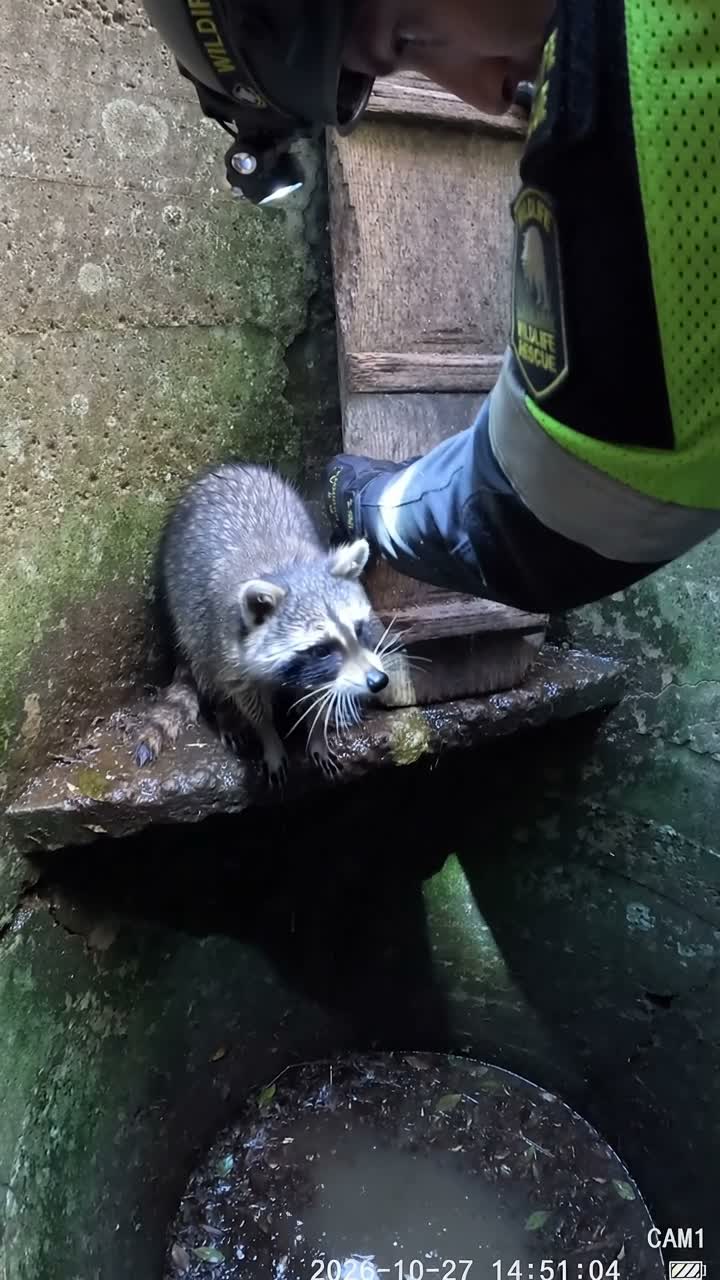
Old concrete wells are among the most dangerous things in the countryside, precisely because they look so harmless: a low wall, a dark opening, a circle of damp stone, often half hidden by weeds. Animals fall into them the way people fall into bad habits — gradually, and then all at once. The raccoon in this story had fallen into just such a well, and by the time it was found, it was clinging to a narrow ledge above the stagnant water at the bottom, its grey fur dark with damp, its masked face turned upward toward the circle of sky, its ringed tail wrapped tight around its body for balance.
Raccoons are clever animals, famously so, and this one had clearly been working the problem: it had found the ledge, it had found a few cracks in the concrete to grip, but it had not found a way up, because the walls were smooth, vertical, and far too high for even the most resourceful raccoon to climb. It watched the rescuer’s torchlight with the wary intelligence of an animal that is used to solving its own problems and is not entirely pleased to need help with this one.
The rescue was, in engineering terms, almost laughably simple: a wooden board, lowered into the well at an angle, with small footholds cut into it, one end resting on the ledge where the raccoon waited, the other end braced at the top of the well. No harness. No net. No one climbing down into a confined, oxygen-poor space — because the first rule of well rescue, for humans and animals alike, is that you do not turn one trapped creature into two. The board was the whole plan, and the plan depended entirely on the raccoon being willing to use it.
For a while, it seemed like it might not. The raccoon sniffed the board, touched it with one paw, and pulled back, as if it suspected a trick. The rescuer waited, torch steady, saying nothing. And then, with the careful deliberation of an animal that has weighed its options and found only one, the raccoon stepped onto the board, found the first foothold, and began to climb — slowly, surely, its claws gripping the wood, its body low, its tail out behind for balance. It climbed past the damp zone, past the moss, past the halfway mark, and then it was at the top, scrambling over the rim and onto the grass, where it paused, shook the water from its fur in a great spray, and looked back down the well exactly once, as if to confirm that it would never, ever do that again.
Then it was gone, into the undergrowth, back to the night world of raccoons: the streams, the trees, the bins it should not raid and will raid anyway. The board was pulled up and the well was marked for covering — because the best rescue is the one that prevents the next one. But on this night, the story ended the way the best stories do: with a clever animal, out of a dark hole, shaking itself dry under the stars, free because someone took the time to lower a board instead of climbing down after it.
The covering went on the following week: a solid cap, fitted and bolted, with a warning sign for good measure, and the weeds around the well were cut back so the next person walking that land could see the danger before they got close to it. It was unglamorous work, and nobody filmed it, but it was arguably the most important part of the whole story, because an uncovered well is a trap that waits patiently for years, collecting victims one by one in the dark. How many animals had fallen into that well before the raccoon? Nobody knows, and that is the point: the ones that did not get out left no story at all. The raccoon’s story exists because someone lowered a board in time, and because someone else came back and closed the hole for good. Rescue is the emergency. Prevention is the cure. And a world with fewer open wells is a world where fewer clever animals have to prove how clever they are, just to survive the night.
