The Hedgehog in the Roadside Drain
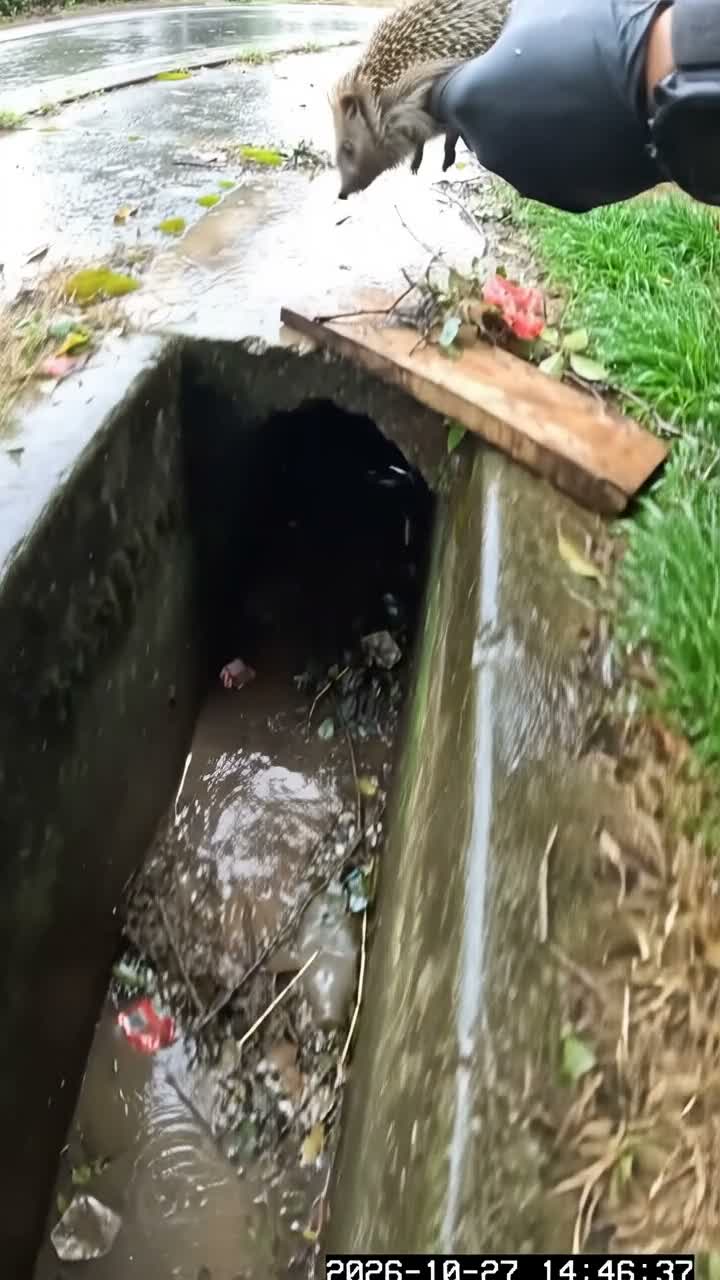
Rain has a way of turning the most ordinary places into traps. A roadside drainage channel, on a dry day, is nothing: a concrete slot in the kerb, easy to step over, easy to ignore. But in heavy rain it becomes a small, fast river, full of swirling water, wet leaves, and the assorted debris that the road sheds — and for a hedgehog, which is a small, round, short-legged animal built for gardens and hedgerows, not for rivers, it can become a dead end with walls too high to climb and a current too strong to fight.
The hedgehog in this story had ended up in just such a channel, on a wet afternoon when the rain was coming down hard enough to blur the world. It was working its way along the concrete, its spines dark with water, its small face set with the determined expression hedgehogs wear when they are doing something difficult, but the way ahead was blocked by a jam of wet leaves and loose plastic debris, washed down from the road above, and the walls on either side offered no purchase for small claws. It kept trying, because hedgehogs are persistent creatures, but persistence against concrete is a losing strategy, and the water was rising.
The rescuer who found it did three things, in order, and the order mattered. First, the debris: the wet leaves and loose plastic were cleared from the channel, lifted out and carried away, so that the way ahead was open and the water could flow past instead of piling up. Second, the ramp: a small wooden board, laid at an angle from the bottom of the channel up to the grassy bank beside the road, its surface rough enough for small feet to grip. Third, and most important: distance. The rescuer stepped back, well back, and waited — because a hedgehog that feels watched will curl into a ball and stay there, and a hedgehog that feels alone will do the bravest thing it knows how to do, which is to walk.
And walk it did. It approached the board cautiously, nose working, spines still half-raised, and then it climbed — slowly, carefully, one small foot at a time — up the ramp and onto the grass, where it paused, shook the water from its spines in a fine spray, and then, with the unhurried dignity of an animal that has just survived something, ambled off into the roadside vegetation, toward the gardens and hedgerows where hedgehogs belong.
It is the smallest rescue in this whole collection. No mountains, no elephants, no drama — just a hedgehog, a drain, a board, and a rainy afternoon. But small rescues are the ones that teach us the most, because they ask the least of us and still change everything for the creature involved. Nobody had to be brave to save this hedgehog. Nobody had to be strong, or rich, or specially trained. Someone just had to notice, to clear the debris, to lay down a board, and to step back. And because someone did, a small, spiny life that could have ended in a concrete channel on a rainy day went on instead — into the grass, into the night, into whatever hedgehog future was waiting for it beyond the road.
That is the thread that runs through all twenty-one of these stories, from the mountain goat to the hedgehog: the world is full of small traps, most of them made by us or by weather we cannot control, and the creatures that fall into them do not need us to be heroes. They need us to notice, to clear the way, and to step back — and to remember, the next time it rains, to check the drains.
That is the thread that runs through all twenty-one of these stories, from the mountain goat to the hedgehog: the world is full of small traps, most of them made by us or by weather we cannot control, and the creatures that fall into them do not need us to be heroes. They need us to notice, to clear the way, and to step back — and to remember, the next time it rains, to check the drains.
If you have read this far, through twenty-one rescues, you have already done the first part of the work: you have noticed. The second part is smaller than you think. It is checking the drain after a storm. It is calling the local wildlife rescue instead of walking past. It is picking up the rope on the beach, capping the old well, fixing the gap in the fence. None of these acts will make headlines. All of them will make the world a place where fewer animals need rescuing in the first place — and where the ones that do can count on a hand reaching out, slowly, patiently, until they are ready to take it. The hedgehog is out of the drain. The goat is back on the mountain. The ducklings are with their mother. And somewhere, right now, another small life is waiting in a dark place for someone to notice. Let that someone be you.
