The Fawn in the Empty Pool
There is something deeply unsettling about an empty swimming pool. Without water, it stops being a place of play and becomes a concrete pit: smooth walls, sharp corners, nowhere to climb, nowhere to hide. The abandoned property where this story happened had one, long disused, its blue paint faded and cracked, its deep end full of nothing but fallen leaves and dust. And standing in the shallow end, on legs that seemed too long and too thin for its body, was a young spotted deer — a fawn that had wandered in through a broken gate and discovered, too late, that the way in was not the way out.
It had tried. You could see the scuff marks on the concrete where its hooves had scrabbled for purchase that was not there. A fawn’s legs are built for grass and forest floor, for springing over fallen branches, not for climbing smooth walls. Every attempt ended the same way: a slip, a stumble, a return to the same patch of concrete, breathing hard, eyes wide, ears swivelling toward every sound. It was exhausted, and exhaustion in a young animal is dangerous, because it leads to panic, and panic leads to injury.
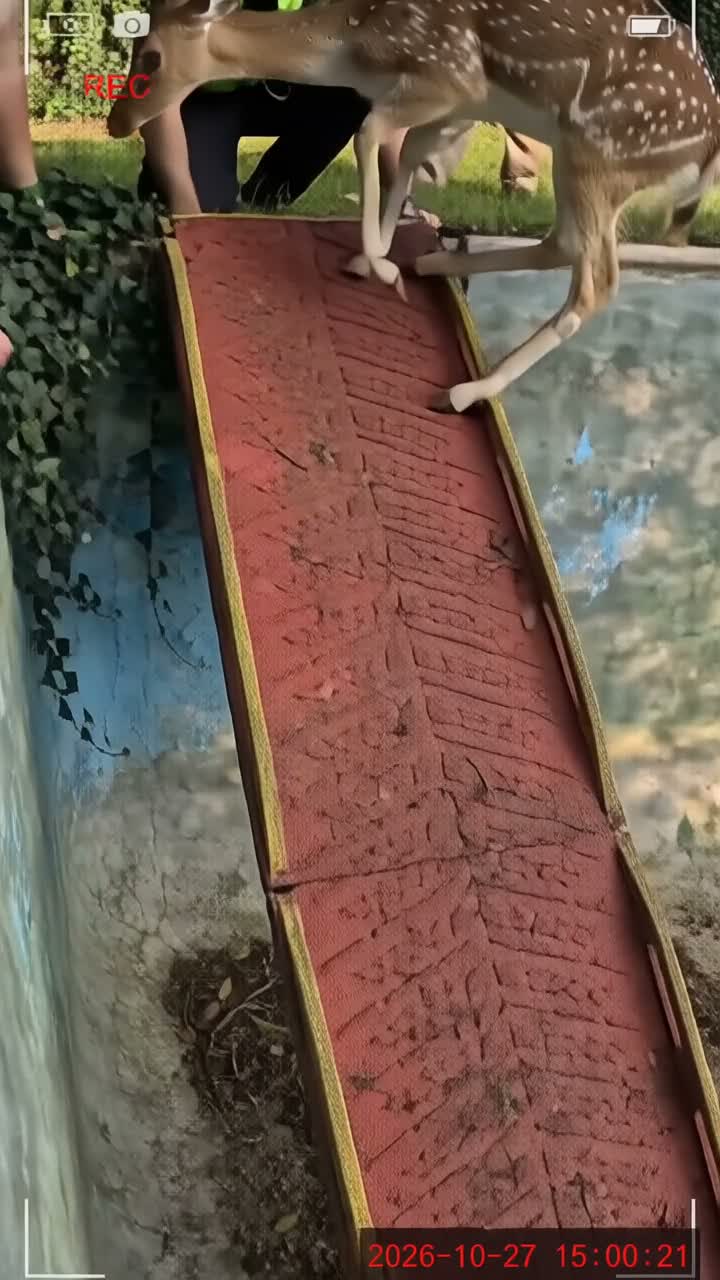
The wildlife responders arrived with a solution that was almost embarrassingly simple: a wide, nonslip rescue ramp, carried between two people, lowered carefully into the shallow end of the pool and braced at the top. No ropes. No nets. No chasing. They positioned it, stepped back, and waited — because the whole point of a ramp is that the animal must choose to use it, and an animal that feels chased will not choose anything except flight, which in a concrete pool means only more slipping and more fear.
The fawn looked at the ramp for a long time. In the footage, you can see the calculation happening: the strange new object, the smell of unfamiliar material, the memory of every surface that has already betrayed it. Then it took a step onto the textured surface, and the surface held. That was the turning point — not dramatic, not loud, just a hoof that did not slide. It took another step, and another, its spotted coat bright against the red-brown ramp, its legs finding a rhythm they had not had since it fell in. Step by step, it climbed out of the pool and onto the surrounding grass, where it stood for a moment, swaying slightly, as if it could not quite believe the ground was level again.
Then it did what deer do when they are free: it ran. Not far — just a few bounding leaps across the grass, toward the trees at the edge of the property, where the world smelled right again. The responders watched it go, and then they took the ramp away, and the pool was empty again, as if nothing had happened. But something had happened, and it was this: a young animal that had spent hours in a concrete trap was back on grass, because a few people decided that its fear was worth an hour of their afternoon and a ramp they already owned. There are worse ways to spend an afternoon. There are, in fact, very few better ones.
By evening, the fawn was back with the small herd that lived at the edge of the property, grazing in the long grass as if the pool had never happened, its spotted coat dry in the last of the sunlight. Fawns grow fast — within weeks, the spots will begin to fade, the legs will lengthen, and this one will be bounding through the trees with the confidence of an animal that has never been trapped. But the people who lowered the ramp will remember the moment its hoof found grip on the textured surface, the moment fear turned into motion, because that moment is the reason they do this work. A ramp is not a dramatic tool. It does not make headlines. But on that afternoon, it was the difference between a young deer spending the night in a concrete pit and a young deer sleeping in the grass, safe, with its herd, under the open sky.
