

The “Spider Egg” Revelation
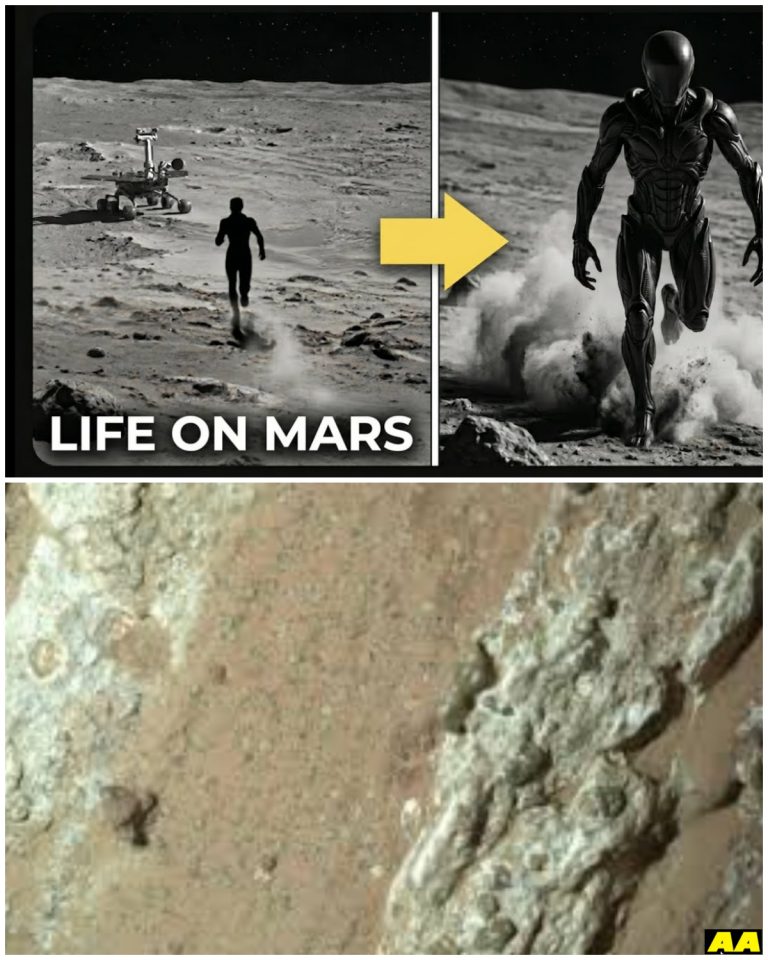
In March 2025, the Perseverance rover was navigating a hill called Witch Hazel near the edge of the Jezero Crater when it transmitted an image that immediately went viral.
It looked, to the human eye, like a clutch of tiny, round eggs, potentially arachnid in origin.
The scientific community held its breath. The Perseverance team quickly analyzed the formation, naming it St.
Paul’s Bay. They identified it as a “float rock,” meaning it did not form where it was found but was moved by a past impact, volcanic activity, or ancient groundwater.
The round textures are likely lapilli—tiny spheres formed when volcanic ash and moisture or meteorite impact debris clump together in the atmosphere.
This single rock could hold clues about Mars’s violent past, but for now, the “spiders” remain purely geological.
Spiders on Mars: The Kiefer Model
The “spider egg” discovery is ironic because it is not the first time scientists have seen “spiders” on Mars.
Since 2003, orbiters have captured vast, dark, crackly patterns that spread across the surface like spider legs, some over 3,000 feet wide.
In 2021, the Kiefer model successfully explained this phenomenon using dry ice (frozen CO2). In Martian spring, sunlight penetrates the clear ice, heating the ground beneath.
This causes the ice to turn directly into gas (sublimation), building pressure until the ice cracks.
Dark sand and dust are then sH๏τ upward, leaving behind the spooky “spider” patterns once the ice completely melts in summer.
NASA scientists even recreated this process in the lab using a barrel-sized chamber nicknamed “Dusty,” which mimics the freezing, low-pressure Martian environment.
The Problem of Pareidolia
The human brain is wired to find familiar patterns in random noise, a phenomenon known as pareidolia.
Mars seems uniquely suited to trigger this glitch in human perception. Over the years, rovers and orbiters have “found” a hardcover book mid-turn, the face of a giant teddy bear, a tiny mineral “flower,” a “doorway” in a cliff (revealed to be a natural fracture), and most famously, the Cydonia “Face on Mars” in 1976.
While these are easily dismissed as tricks of light and shadow, other discoveries are far harder to categorize as mere pareidolia.
The “Blueberry” Blueprint
In 2004, the Opportunity rover discovered small, round, iron-rich rocks nicknamed “blueberries.” These spherules are powerful evidence of a watery past, formed when water smoothed minerals over billions of years.
This discovery re-established Mars as a dynamic, wet world and provided the first tangible clue that we should be looking for environmental remnants of life.

The “Leopard Print” and Biosignatures
In July 2024, Perseverance collected a sample nicknamed Sapphire Canyon from rocky cliffs in the Neretva Vallis river valley.
High-resolution images revealed a “leopard spot” pattern—pale blobs with dark rings. This is the closest humanity has ever come to finding a “biosignature.”
On Earth, these specific patterns form through electron transfer reactions between sediment and decaying organic matter.
Analyzing the spots, scientists identified two iron-rich minerals, vivianite and greigite, that are frequently produced by microbial decay.
Proving this wasn’t abiotic (formed without life) is tricky. To form naturally, these patterns require high temperatures and acidic conditions, neither of which were detected in the Sapphire Canyon sample.
While scientists cannot confirm it is a biosignature 100%, they have been unable to find another credible explanation, leaving the door open to ancient Martian life.
Solving the 50-Year “DicH๏τomy”
Another mystery that has baffled scientists since the 1970s is why Mars is split into two distinct halves: the northern lowlands and the southern highlands.
In December 2024, data from NASA’s Insight lander provided a potential answer. While one theory suggested a moon-sized collision, seismic waves recorded by Insight lost energy faster when traveling through the southern highlands.
This means the mantle beneath the south is significantly H๏τter than in the north. This temperature difference points to ancient, internal tectonic activity—a “stagnant lid” phase where mantle forces pushed the southern crust upward, rather than an external impact.
The InSight Legacy and the Seismic Highway
Although NASA decommissioned the InSight lander in 2022 due to dust accumulation, its data remains invaluable.
The lander recorded over 1,300 “Mars quakes.” By analyzing how seismic waves travel, scientists made a shocking discovery about the Cerberus Fossae impact crater: it revealed a direct, deep path through the planet’s mantle—a “seismic highway” that allows quakes to travel much farther than previously believed.
The mission proved that Mars gets hit by meteoroids 2.5 times more often than previously thought, piece by piece rewriting our understanding of the Red Planet’s deep structure.
The search for life continues, but we are no longer looking for spiders; we are looking for sauce drops.