Cardi B Issues Apology After Controversial Photoshoot Inspired by Hindu Goddess Durga Sparks International Backlash
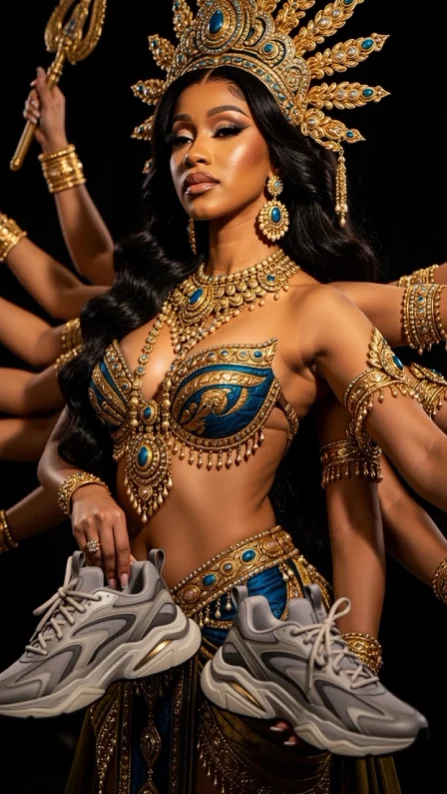
Cardi B found herself at the center of an international cultural controversy in November 2020 after a fashion photoshoot inspired by the Hindu goddess Durga triggered criticism from members of the Hindu community.
The Grammy-winning rapper, who has become widely recognized for her fearless personality, extravagant fashion choices, and unconventional artistic expression, appeared on the November cover of Footwear News in a visually striking photoshoot that quickly attracted attention for reasons beyond fashion.
The concept featured Cardi B dressed in an elegant strapless gown designed by Georges Hobeika. She posed with multiple arms, recreating the traditional visual representation of Goddess Durga, one of the most powerful and respected figures in Hinduism.
However, there was one significant difference between the traditional religious imagery and the fashion campaign. Instead of holding the weapons and sacred objects commonly associated with the goddess, Cardi B was photographed holding sneakers from her collaboration with Reebok.
The images were created to promote her Club C Cardi sneaker collection. Although the campaign was intended to present a message of strength, confidence, and femininity, the religious inspiration behind the photographs quickly became a subject of controversy.
Why the Photoshoot Sparked Widespread Criticism
To understand the reaction, it is important to recognize the cultural and religious significance of Goddess Durga.
In Hinduism, Durga represents divine feminine power, courage, protection, and the victory of good over evil. She is traditionally depicted with multiple arms, each carrying symbolic weapons or objects that represent her ability to overcome evil forces and protect the world.
For millions of Hindus, the goddess is not simply a mythological character or an artistic symbol. She is a sacred figure who receives devotion, prayers, and deep religious respect.
Some viewers felt that using this imagery in a commercial fashion campaign crossed an important cultural boundary.
The fact that Cardi B appeared in a glamorous fashion pose while holding sneakers instead of traditional religious objects was particularly controversial.
Critics also highlighted the cultural significance of footwear in Hindu religious spaces. Shoes are traditionally removed before entering temples and other sacred areas. As a result, incorporating sneakers into an image inspired by a revered goddess was considered inappropriate by some members of the community.
The criticism quickly spread across social media platforms, where people questioned whether the creative team had sufficiently researched the religious traditions and cultural meaning behind the imagery.
For many critics, the problem was not simply that a celebrity had borrowed inspiration from another culture. It was that a sacred religious figure had been incorporated into a commercial advertisement without sufficient consideration of the beliefs associated with that figure.
Cardi B Responds to the Backlash and Apologizes
As the controversy continued to attract attention, Cardi B addressed the criticism through her Instagram account.
The rapper explained that the creative team had introduced the concept to her as an artistic representation of a goddess associated with strength, femininity, and freedom.
She said these were qualities she admired and wanted to communicate through the photoshoot.
Cardi B also explained that she had not intended to disrespect Hinduism or make fun of anyone’s religious beliefs.
However, she acknowledged that understanding the intention behind an artistic concept did not necessarily change how the final images affected other people.
In her response, she apologized to those who felt offended by the photographs and expressed regret that the campaign had caused hurt within the Hindu community.
She emphasized that she respected different religions and did not want her fashion campaign to be interpreted as an attack on anyone’s culture or faith.
Her response also reflected a broader realization that international celebrities must consider how their creative decisions may be received by audiences with different cultural and religious backgrounds.
Although Cardi B had initially viewed the concept as a celebration of feminine strength, the reaction demonstrated that an image intended to communicate empowerment could carry a very different meaning to people who viewed the religious symbolism as sacred.
Footwear News Also Acknowledges the Controversy
Cardi B was not the only party to respond to the criticism.
Footwear News, the publication responsible for the cover and photoshoot, also acknowledged that the images had caused offense.
The publication admitted that the creative team should have conducted more thorough research before choosing religious imagery for a commercial fashion campaign.
This acknowledgment was significant because it highlighted that responsibility for cultural sensitivity does not belong exclusively to the celebrity appearing in an advertisement.
Fashion publications, photographers, stylists, designers, advertising agencies, and commercial partners all contribute to the creation of a campaign.
When a project incorporates symbols associated with a particular religion or community, the creative team has a responsibility to understand their meaning and consider how they may be interpreted.
The incident therefore became part of a larger conversation about cultural awareness in the global fashion and entertainment industries.
The Debate Between Creative Freedom and Cultural Respect
Fashion has always drawn inspiration from different cultures, historical periods, artistic movements, and religious traditions.
Designers regularly incorporate traditional clothing, symbolic patterns, architectural influences, and cultural references into their collections.
Such inspiration can create meaningful artistic connections between different communities. However, it can also generate controversy when sacred symbols are used without sufficient understanding or sensitivity.
The Cardi B photoshoot illustrated how quickly a creative concept can become controversial when it involves religious imagery.
For some people, the campaign represented an attempt to celebrate feminine power through an internationally recognizable symbol. For others, it crossed a boundary by transforming a sacred religious figure into part of a commercial product advertisement.
These different perspectives demonstrated that creative intention and public interpretation do not always align.
The controversy also raised an important question for fashion brands and celebrities: How can artists explore cultural inspiration while ensuring that the traditions they reference are treated with respect?
A Lesson That Continues to Matter in the Fashion Industry
Cardi B has built her public image around bold self-expression, dramatic fashion statements, and a willingness to experiment with unconventional visual concepts.
Throughout her career, she has frequently attracted attention through extravagant outfits, high-profile collaborations, and creative campaigns that challenge traditional fashion expectations.
However, the 2020 controversy demonstrated that artistic creativity can have consequences when it involves symbols that hold deep religious significance.
Although Cardi B apologized and clarified that offending anyone had never been her intention, the incident remains a notable example of the importance of cultural awareness in international advertising.
For celebrities with millions of followers across different countries, a single photograph can reach audiences with very different traditions, beliefs, and expectations.
A fashion campaign may begin with an idea of beauty, empowerment, or artistic expression, but its impact can extend far beyond the original creative vision.
Ultimately, the controversy surrounding Cardi B’s Goddess Durga-inspired photoshoot served as a reminder that fashion is not only about appearance. It is also about understanding the cultural messages behind the images, respecting the communities they represent, and recognizing the responsibility that comes with having a global platform.
